

When comparing an industrial coffee roaster, the discussion often starts with capacity and burner power. That is understandable: both figures are easy to include in a technical specification and useful when sizing an installation. Yet neither one, on its own, answers the question that ultimately matters most to operating cost: how much energy is required to produce one tonne of roasted coffee that meets the defined roast profile and quality requirements?
Assessing energy efficiency in industrial coffee roasting requires looking at the complete process. In a real coffee roasting plant, energy consumption depends on batch size, green coffee moisture, roast loss, roast profile, airflow, discharge temperature, time between batches and the auxiliary equipment included within the measurement boundary. A single figure may therefore look precise while providing very little basis for a meaningful comparison.
NOMINAL POWER DOES NOT EXPLAIN ACTUAL ENERGY CONSUMPTION
ENERGY + PRODUCT + TIME + PROCESS CONDITIONS
To assess energy efficiency, measured data must be compared within the same system boundary and using a clearly defined mass basis.
The first decision: define what is being measured
Before comparing months, recipes or equipment, define the measurement boundary. Does it include only the coffee roaster burner? Does it also include the afterburner, fans, cooler, pneumatic conveying and emissions treatment? Different boundaries are valid, but they answer different questions.
• Equipment boundary: tracks the thermal performance of the industrial coffee roaster.
• Line boundary: includes the auxiliary equipment required to deliver roasted coffee ready for the next processing stage.
• Plant boundary: adds shared utilities, waiting periods, start-ups and shutdowns. It is closer to actual operating cost, although it is also more difficult to benchmark.
The mass basis must also be stated explicitly: kilograms of green coffee charged or kilograms of roasted coffee discharged. Because roasting reduces product mass, mixing the two bases changes the result.
Industrial coffee roasting efficiency: what should you measure?
Specific thermal energy
One of the most useful indicators is thermal energy consumed divided by the mass processed. When gas consumption is measured, volume should be converted into energy using the calorific value stated by the supplier, specifying whether the lower or higher heating value is used. The result can be expressed in kWh/kg or kWh/t.
Nm³ of gas per tonne
Normalised gas volume per tonne is an intuitive KPI for operations and purchasing. The reference conditions used by the meter or supply contract should be recorded, while the corresponding energy figure should also be retained because gas composition and calorific value may vary.
Specific electricity consumption
Motors, fans, extraction systems, cooling, controls and conveying equipment also consume energy. Measuring electrical kWh per kilogram prevents an apparent thermal improvement from simply shifting energy use to other equipment without showing up in the overall balance.
Cycle time and effective throughput
Roasting time is only one part of the cycle. Effective throughput should account for loading, roasting, discharge, cooling and the time required to return to loading conditions.
WORKING FORMULA
SPECIFIC THERMAL ENERGY = ENERGY CONSUMED ÷ COFFEE MASS
For consistent comparisons, keep the measurement boundary, mass basis and LHV/HHV criterion unchanged.
Why nominal burner power is not enough
A higher-power burner can deliver energy more quickly, but operating cost depends on how long it runs and how it modulates. Two recipes on the same industrial coffee roaster can produce different specific energy consumption. The same is true for two shifts producing the same coffee if one includes more waiting time, cold starts or partial batches.
For energy efficiency in industrial coffee roasting, the useful comparison is not rated power against rated power. It is measured energy per unit of product, under an equivalent recipe and using the same quality criteria. Process control matters as much as installed capacity.
Air circulation inside the roasting chamber — how process air is directed, distributed and renewed around the coffee — and the chamber design itself can have a major influence on specific energy consumption. Industrial coffee roasters with similar burner ratings can behave very differently depending on how internal airflow and heat transfer are managed.
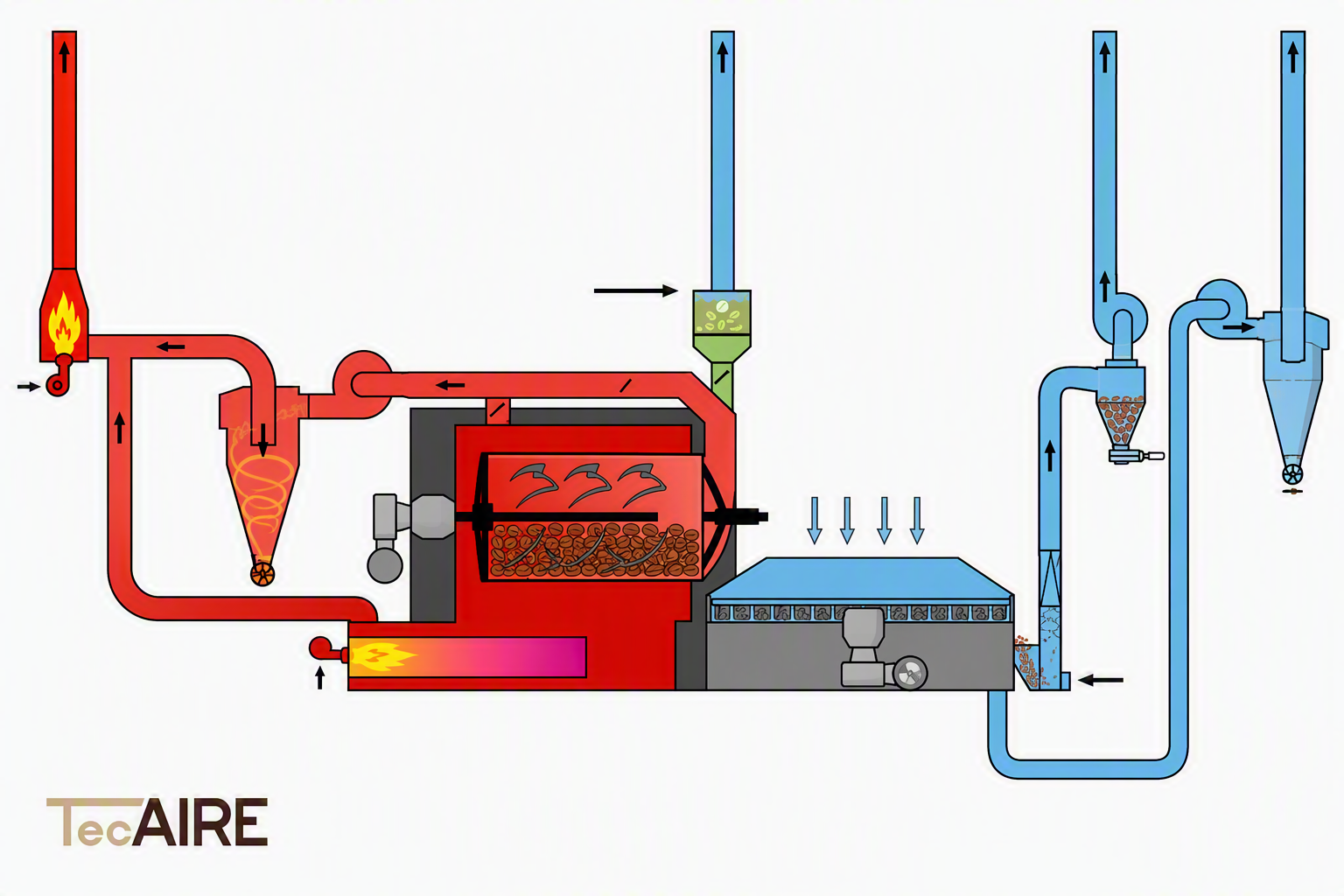
Variables that change the thermal balance
Thermal insulation
Effective insulation limits heat losses through hot surfaces and helps stabilise the coffee roasting process. Its actual condition matters: seals, access points, ducts and thermal bridges can deteriorate over time. Thermographic inspection and surface-temperature monitoring can help identify deviations, but any energy saving should be confirmed through before-and-after measurements under comparable operating conditions.
In drum roasters, drum construction also affects heat transfer and thermal losses. Perforated, single-wall and double-wall configurations interact differently with the heating environment. The relevant point for energy assessment is to evaluate the complete thermal design — including insulation, heat-transfer surfaces and airflow — rather than assuming performance from one construction feature alone.
Hot-air recirculation
Recirculating part of the process air can reduce the energy required to heat fresh air. It is not simply a matter of increasing the return-air percentage: moisture, smoke, particles, volatile compounds, pressure and roast-profile stability must remain under control.
Recirculation is most useful when the industrial coffee roaster allows it to be enabled or disabled according to the recipe and product requirements. Depending on the coffee and desired sensory profile, recirculated air may not always be appropriate. Process flexibility therefore takes priority over pursuing an isolated energy-saving figure.
Where process air is recirculated, it must be suitably treated before returning to the roasting chamber so that contaminants and impurities remain controlled.
Roasting technology: drum or hot air
Drum and hot-air or fluid-bed roasting technologies use different heat-transfer mechanisms, airflow strategies and process conditions. Their energy performance should therefore be compared through specific energy consumption under equivalent product, throughput, roast profile and quality requirements rather than through technology labels alone. The appropriate solution depends on the product and the process objective as well as energy use.
Combustion control
Burner modulation should follow the thermal demand of the roast profile rather than operate as an oversized on/off source. Useful diagnostic data may include control signal, fuel flow, temperature, airflow and, where appropriate, oxygen and carbon monoxide in the flue gas.
Burner configuration can also affect the available modulation strategy. Systems using separate heat sources for roasting and emissions treatment can control the thermal requirements of each function independently. Where functions share a heat source, the operating strategy should be assessed under actual production conditions. In either case, energy performance must be verified from measured consumption rather than inferred from burner configuration alone.
Open or closed air circuit: process flexibility matters
Open- and closed-circuit roasting systems manage process air differently. Their suitability depends on the range of coffees, roast profiles, emissions strategy and required process flexibility. When comparing industrial coffee roasting equipment, the circuit configuration should therefore be evaluated against the actual product portfolio and operating requirements rather than treated as a universal indicator of efficiency.
Heat recovery
The exhaust from a coffee roasting line contains energy, but recovering it requires a compatible use in both time and temperature. Preheating process air, green coffee or other plant services are among the options studied by the industry. Feasibility depends on the cyclic nature of roasting, gas cleanliness, pressure drop, condensation, hygiene and the timing of the heat source relative to demand.
Studies of coffee roasting plants show why heat recovery should be analysed dynamically, cycle by cycle.
Batch capacity
Operating well below design batch capacity can spread fixed losses over fewer kilograms of coffee. Maximum loading does not automatically deliver the best result either if it lengthens the cycle or affects repeatability. The economically useful operating point is the one that combines throughput, process consistency and specific energy consumption.
Roast profile
A roast profile changes cycle duration, thermal demand, airflow and discharge temperature. It also affects roast loss. Comparing kWh per kilogram without recording the recipe and quality outcome can therefore optimise the wrong variable. Energy efficiency should be treated as a process constraint alongside product quality, not as an isolated objective.
Start-ups, waiting time and production sequencing
Start-up heating and idle periods remain part of operating cost. Grouping compatible recipes, reducing gaps between batches and measuring complete production campaigns can reveal improvements that do not require equipment modifications. Production planning is also part of energy engineering.
Control and data: the basis of efficient operation
Energy efficiency in industrial coffee roasting also depends on data quality. Good measurement starts with process control. An HMI can provide visibility of cycle times, temperatures, setpoints, equipment status, recirculation, power demand and alarms throughout the roasting process.
Illustrative values. The data shown are used solely to explain system functionality and do not correspond to actual operating values.
A practical KPI dashboard from day one
For each production campaign or recipe, a practical record should include:
• date, equipment, recipe and operator;
• mass of green coffee and roasted coffee;
• initial and final gas readings, calorific value and LHV/HHV basis;
• electricity consumption for the defined line or auxiliary equipment;
• heating, production, waiting and cleaning times;
• number of batches, average batch load and complete cycle time;
• key temperatures, airflow values or positions and burner control signal;
• roast loss, colour and agreed quality controls.
These data help separate three issues that are often mixed together: how much energy the recipe requires, how much operating practice affects consumption, and how much is associated with losses or limitations in the installation.
From a snapshot to a trend: baselines and performance indicators
A single kWh/kg value is only a snapshot. To determine whether a coffee roasting plant is genuinely improving, a time series and an energy baseline linking consumption to production are required. Published work on a coffee roasting facility shows the value of combining consumption indicators with monitoring tools such as cumulative sums, or CUSUM, to distinguish a one-off variation from a sustained change in energy performance.
In practice, this means comparing equivalent production campaigns and contextualising deviations: coffee blend, incoming moisture, average batch load, roast profile, waiting time and the equipment included within the boundary. This reduces the risk of attributing to the machine what may actually come from the product or production schedule, while helping detect gradual efficiency losses earlier.
Calculation example — hypothetical data
A line consumes 72 Nm³ of gas and 18 kWh of electricity during a production campaign that processes 1,000 kg of green coffee and delivers 840 kg of roasted coffee. For this hypothetical example, assume the gas supplier states 10.5 kWh/Nm³ on an LHV basis:
• Thermal energy: 72 × 10.5 = 756 kWh.
• Thermal consumption per green coffee mass: 0.756 kWh/kg green.
• Thermal consumption per roasted product mass: 0.900 kWh/kg roasted.
• Specific gas consumption: 85.7 Nm³/t of roasted coffee.
• Specific electricity consumption: 0.021 kWh/kg of roasted coffee.
Important: this example does not represent the performance of a TecAIRE industrial coffee roaster and is not a universal benchmark. Its purpose is to show why the mass basis, calorific value and equipment included within the measurement boundary must be stated.
MEASURE · COMPARE · OPTIMISE
ENERGY EFFICIENCY STARTS WITH UNDERSTANDING THE REAL PROCESS
Sometimes the improvement lies in the equipment; in other cases, in control, maintenance or production planning. It is usually found by looking at the complete system.
How to approach an energy-efficiency project with TecAIRE
TecAIRE manufactures industrial coffee roasters and develops process solutions for different capacities and applications. In an energy-efficiency project for a coffee roasting plant, a sound starting point is to characterise actual production: product range, roast profiles, production campaigns, available utilities, emissions treatment and capacity targets.
From this information, measurement points can be defined and the relevant opportunities assessed for each project, including insulation, airflow distribution and recirculation, thermal modulation, production sequencing and heat recovery. Conclusions — and any projected savings — should be based on project-specific data rather than generic comparisons.
Explore TecAIRE industrial coffee roasters and the solutions available for different applications and production capacities.
For projects integrating several process stages, see TecAIRE complete coffee processing plants.
The final question is not how many kW the burner has
The more useful question is: how many kWh does the line require to produce one kilogram of compliant roasted coffee, at the throughput and roast profile required by the business? Answering it requires reliable measurement, but it also leads to much more specific engineering decisions.
Sources and references
1. Fórum Café, “El tueste de café mira al futuro”, issue 99 (2024).
2. Fórum Café, “Innovación: máquinas de tostar café” (2018).
3. Ibarguen-Valverde et al., “Indicadores de desempeño energético: una ruta hacia la sustentabilidad. Caso de estudio una industria torrefactora de café”, DYNA 84(203) (2017), 184–191.
4. Tea & Coffee Trade Journal, “High tech is key to reducing coffee roasting’s carbon footprint” (8 August 2023).
5. STiR Coffee and Tea Magazine, “Clean Roasting Emissions with Electrostatic Precipitation” (25 August 2025).
6. Pantaleo et al., “Integrating cogeneration and intermittent waste-heat recovery in food processing: Microturbines vs. ORC systems in the coffee roasting industry”, Applied Energy 225 (2018), 782–796.
7. Bianchi et al., “Numerical analysis of the heat recovery efficiency for the post-combustion flue gas treatment in a coffee roaster plant”, Energy 141 (2017).
8. TecAIRE, “Industrial Coffee Roasters”.
Would you like to assess the energy efficiency of your coffee roasting process?
Talk to TecAIRE
