

Industrial coffee roasting allows us to save a roasting recipe and reproduce it as many times as required. We can repeat times, temperatures, valve positions, burner power and fan speeds. However, repeating exactly the same setpoints does not necessarily mean obtaining exactly the same coffee.
For me, this difference between repeating a recipe and repeating a result is one of the most interesting aspects of industrial coffee roasting.
When we work on an industrial scale, consistency does not depend on a single variable. Green coffee changes, the roaster accumulates energy, environmental conditions vary, and the air, combustion and extraction systems are also subject to small deviations.
Therefore, if we really want to understand roasting repeatability, we must stop looking only at the temperature curve and analyse the process as a complete system.
Green coffee is our first variable
Before discussing the coffee roaster, we must start with the product that we put into it.
Coffee is an agricultural raw material, and not every batch has exactly the same characteristics. Moisture, density, bean size, variety, processing method, storage conditions and the temperature of the beans before they enter the roaster can all affect their thermal behaviour.
This is especially important in industrial production. Coffee stored at 15°C does not begin the process under the same energy conditions as the same coffee at 25°C. Likewise, beans with different moisture levels or densities do not absorb and transfer energy in exactly the same way.
Research into batch coffee roasting shows that bean temperature and moisture loss evolve together, and that the process can be modelled through heat- and mass-transfer phenomena.
Roasting consistency therefore begins before the coffee reaches the roaster. The better we understand and stabilise the characteristics of the raw material, the less variability we introduce into the process.
Roasting means transferring energy to the coffee
When we discuss coffee roasting, we constantly use temperature as a reference. This is logical, but temperature and energy are not exactly the same thing.
During roasting, heat is transferred to the beans through different mechanisms—convection, conduction and radiation—whose relative importance depends on the design and technology of the coffee roaster.
From an industrial perspective, what really matters is ensuring that the amount of energy reaching the coffee, and the way in which it is delivered, can be controlled and reproduced.
Physical models of coffee roasting describe the simultaneous evolution of heat, moisture and mass transport inside the bean. They show why an external temperature curve alone does not represent everything happening during the process.
This is the first important point: the curve explains part of the process, but not everything taking place inside the bean.
Airflow is also part of the recipe
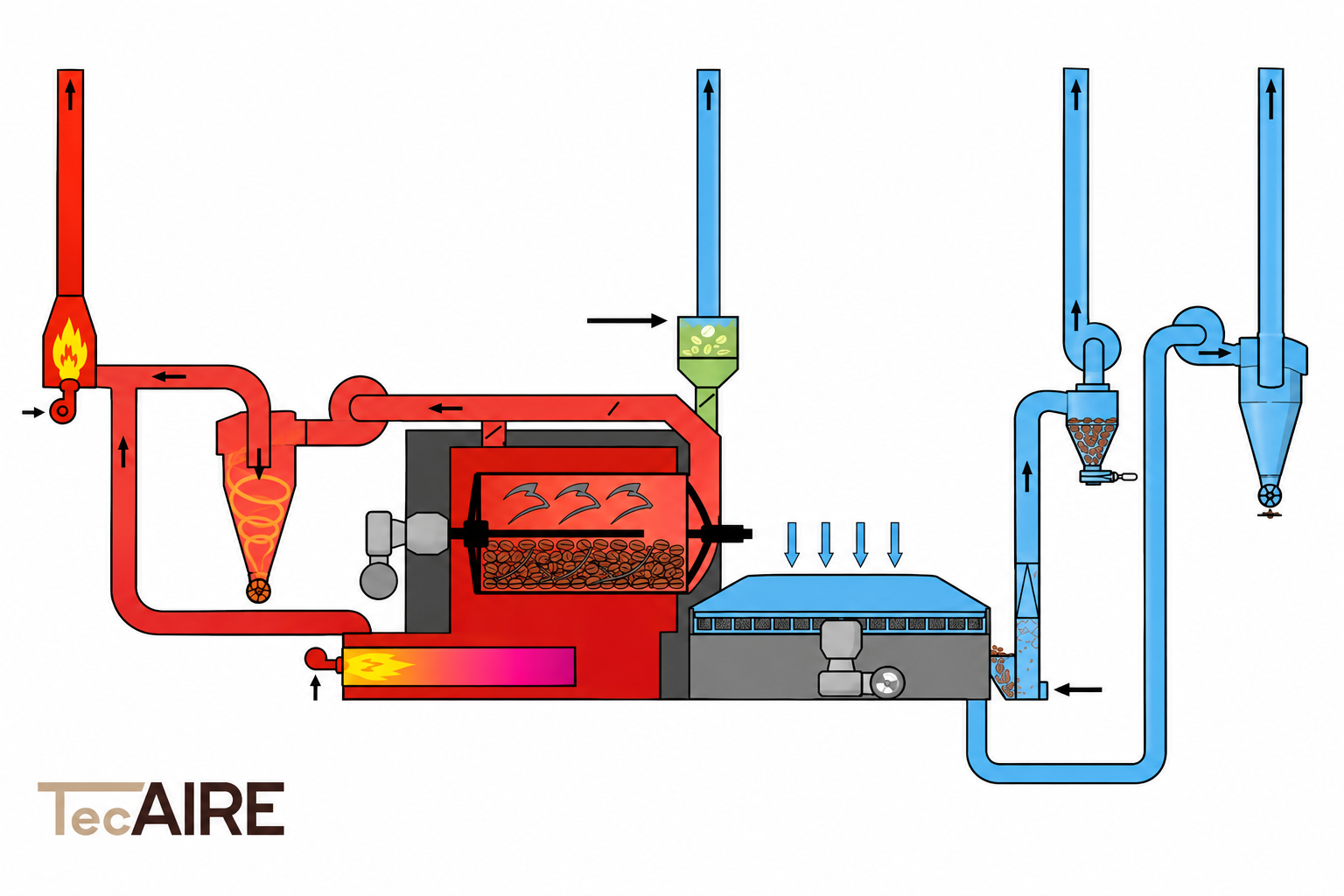
Air plays a fundamental role in an industrial coffee roaster. It transfers energy to the product, while also helping to remove moisture, smoke, gases and particles generated during roasting.
Changing the airflow therefore means changing the process. This introduces an industrial factor that sometimes receives less attention than temperature: the actual airflow does not depend solely on the programmed value.
Fans, ducts, valves, cyclones, filters and extraction systems are all part of the circuit. Their condition can alter the actual operating conditions.
In TecAIRE’s INNOVA range, heat transfer is based mainly on convection, while the PLC adjusts roasting times and temperatures to achieve consistent results across roasting profiles.
This also explains why maintenance is part of consistency. We may not have changed the recipe, but the physical conditions under which it is being executed may have changed.
A coffee roaster also has a thermal memory
Another variable that I consider particularly important in production is the thermal condition of the machine before a new batch is loaded.
The first roast after start-up does not necessarily take place under the same conditions as the fifth or tenth roast. As production continues, different metal masses, ducts and installation components absorb and accumulate energy.
Put simply, the coffee roaster has a thermal memory.
It is therefore not enough to monitor a single charge temperature. We need to achieve sufficiently stable and repeatable starting conditions. Warm-up and stabilisation procedures, together with the time between batches, are particularly important.
We must prepare not only the coffee for the roaster, but also the roaster for the coffee.
Batch load changes the energy balance
Another obvious but fundamental factor is the amount of product. Changing the number of kilograms loaded changes the relationship between the available energy and the mass that must absorb it.
This is why transferring a roasting profile from a small machine to an industrial installation is not simply a matter of multiplying times or temperatures.
Batch capacity, machine geometry, product movement, available airflow and thermal power form a complete system. This system is what we need to control.
What does temperature really tell us?
Sensors are the eyes of the control system. However, a sensor does not measure an abstract concept called “coffee temperature”. It measures temperature at a specific point and under specific conditions.
Its position, diameter, response time, contact with the product and exposure to airflow all influence the reading. This has practical consequences: if we replace a probe, change its position or compare two different coffee roasters, we should not automatically assume that identical numerical values represent exactly the same physical state.
The same applies to indicators derived from that signal, such as Rate of Rise (RoR). They are extremely useful tools for interpreting the development of a roast, but they still depend on the quality and processing of the data they receive.
Instrumentation, calibration and sensor maintenance are therefore not secondary considerations: they are part of controlling the coffee roasting process.
An identical curve does not necessarily guarantee identical coffee
At this point, we can ask an important question: if two temperature profiles are practically identical from charge to discharge, can we conclude that the two coffees are the same?
Not necessarily. The curve is a representation of the process, but our industrial objective is not to manufacture curves. We manufacture roasted coffee.
To evaluate repeatability, we must therefore also examine the finished product. Colour, weight loss, final moisture, density and sensory evaluation can complement the data recorded by the coffee roaster.
The more process and product data we can relate, the better we can determine whether two batches are genuinely equivalent.
Cooling also determines repeatability
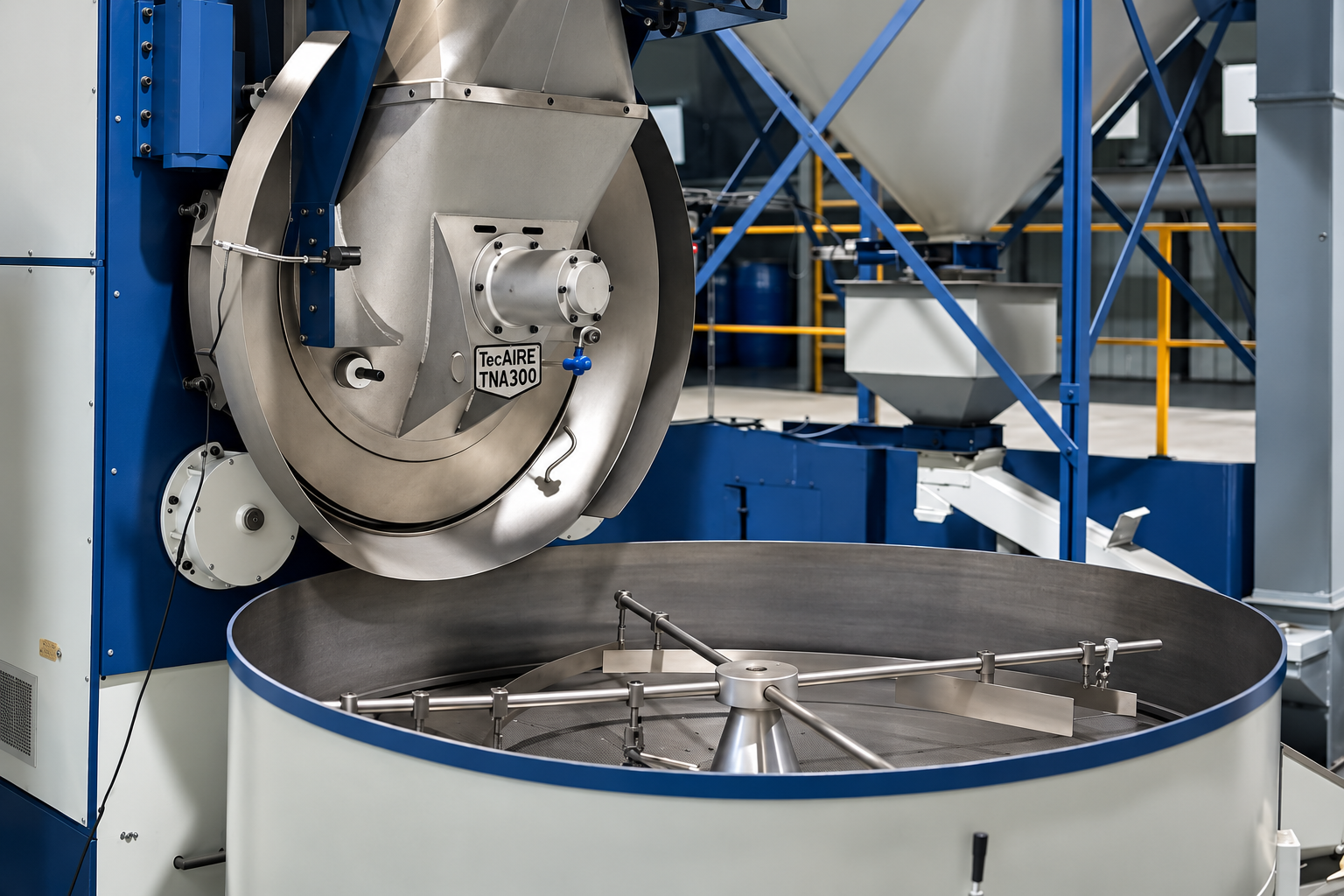
The thermal process does not simply end when the discharge door opens. The coffee leaves the roasting chamber with a considerable amount of accumulated energy, which must be removed quickly.
The cooling of roasted coffee must therefore also be consistent. Airflow, batch size, cooling time and final temperature are all conditions that should be repeatable.
If we control roasting with great precision but treat the product differently during the following minutes, we introduce another source of variability.
Automation: repeating commands or controlling the process
This is where coffee roasting automation becomes particularly relevant.
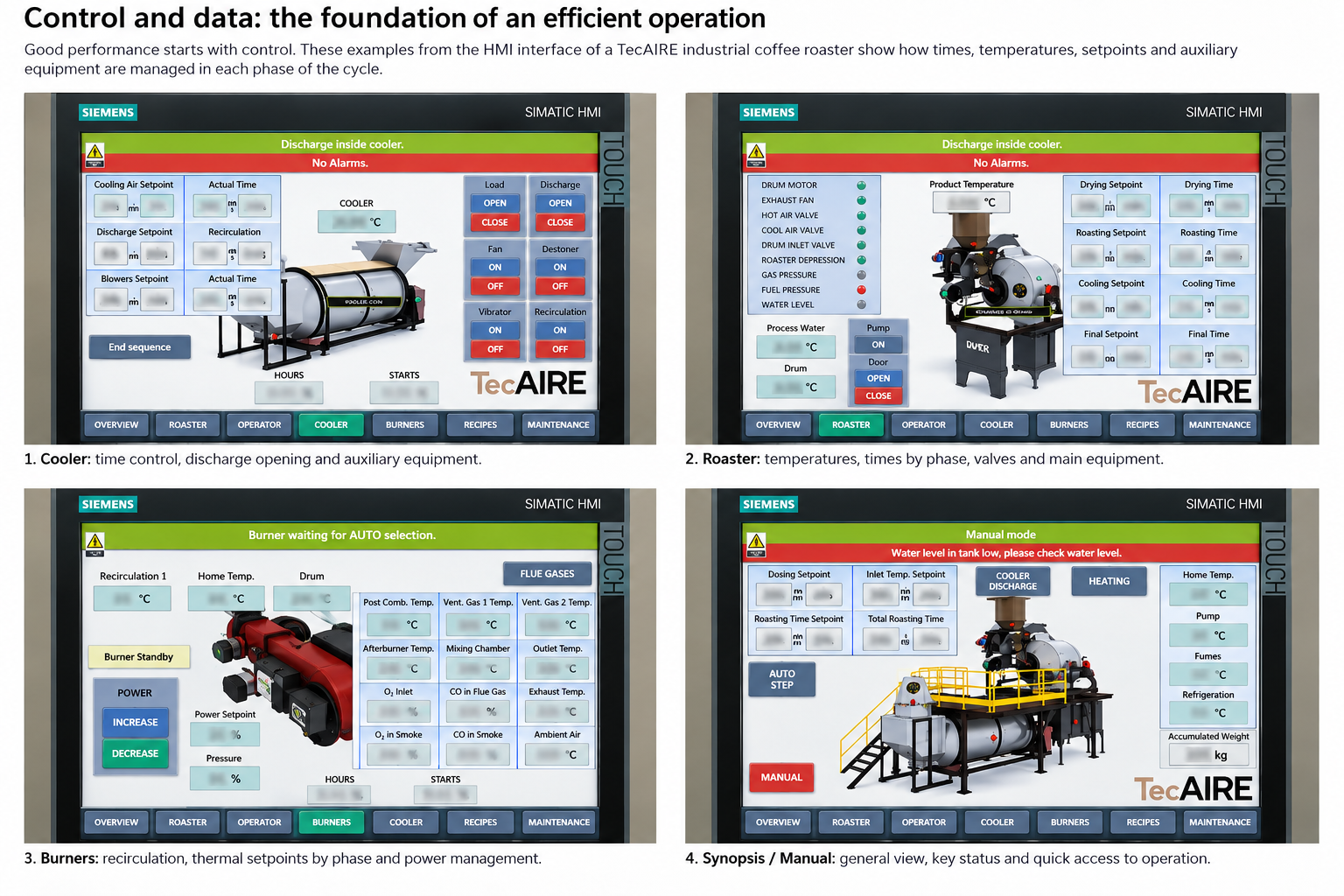
A PLC can store a recipe and execute exactly the same sequence repeatedly. This provides operational repeatability, but we can aim for more.
We can record temperatures, process parameters, batches and trends; compare cycles; establish tolerances; and generate useful information for quality and production teams. In TecAIRE’s COFFEETEC range, for example, the control system includes dual PLCs, HMI, SCADA, recipe storage, traceability, and the recording of curves and parameters for every cycle.
Technology allows us to progress from repeating commands to controlling results. Research into heat and mass transfer also proposes models designed for the online estimation and control of the roasting process.
As instrumentation increases and better data becomes available, we can understand why a batch is beginning to deviate before the difference becomes apparent in the finished product.
Repeatability is a property of the complete installation
When a quality deviation appears, it is tempting to look immediately at the coffee roaster. However, an industrial installation is much more than a single machine.
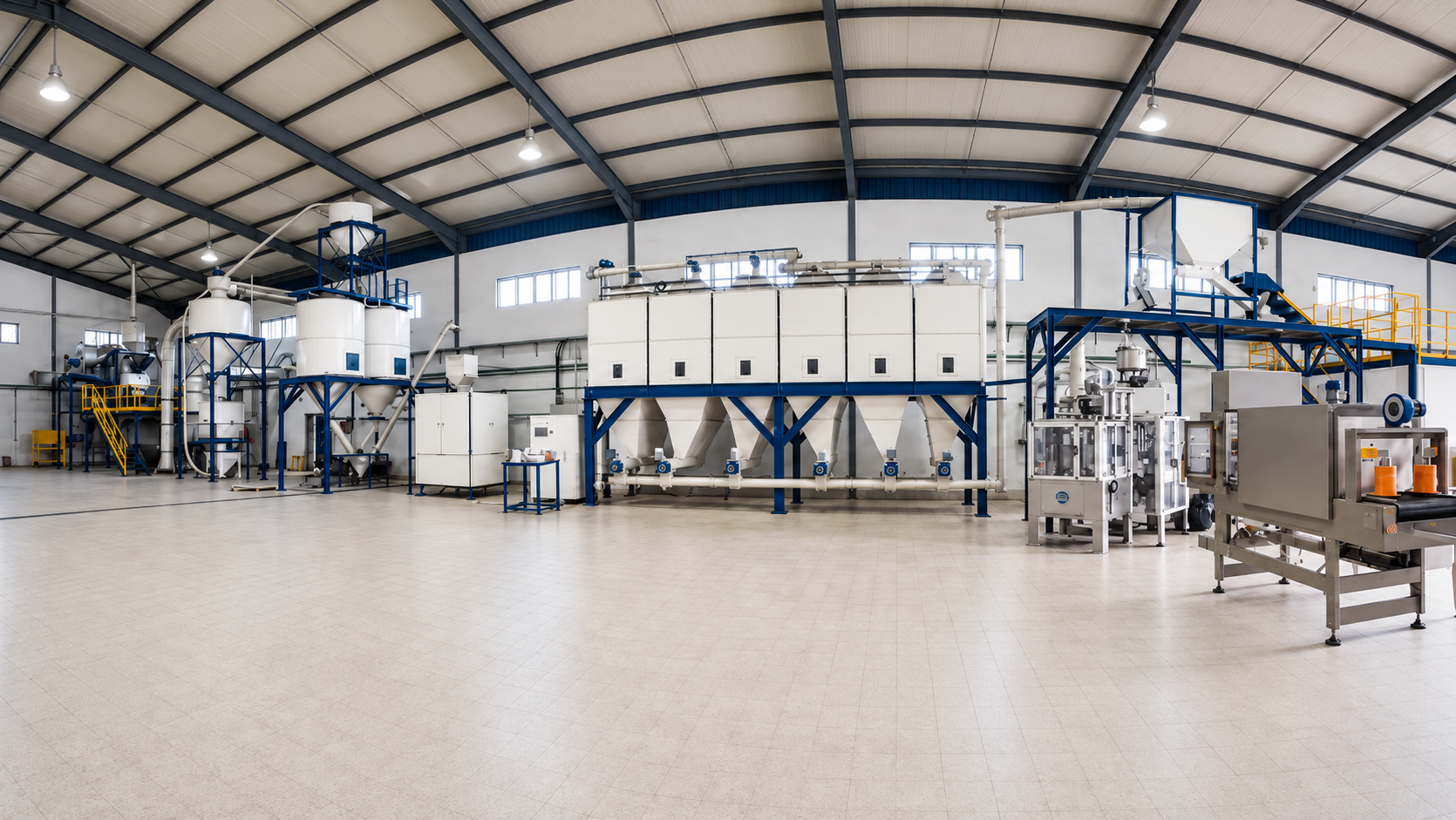
Green coffee reception and storage, conveying, dosing, roasting, cooling and subsequent storage are all part of the same process chain.
Feed stability, weighing accuracy, product conveying and plant automation can directly or indirectly influence consistency. This overall perspective becomes especially important as production capacity increases.
Which variables determine industrial coffee roasting results?
If I had to summarise the repeatability of an industrial coffee roasting process, I would not look for a single master variable.
I would consider the complete system: raw material + thermal condition of the machine + energy + airflow + batch load + time + instrumentation + cooling + final result.
The challenge lies precisely in the interaction between all these variables.
A good industrial coffee roaster must provide the tools required to control them precisely. However, final consistency also depends on how we design, operate and maintain the complete process.
At TecAIRE, this approach is integrated into the design of its industrial coffee roasters and the control systems associated with the process.
Repeating a recipe is not the same as repeating a result
This is my conclusion.
We can store a recipe and repeat exactly the same commands one hundred times. However, across those one hundred batches, the green coffee, the initial product temperature, the thermal condition of the machine, the actual airflow or the conditions of the installation may change.
True consistency in industrial coffee roasting therefore does not mean making the machine do exactly the same thing every time.
It means ensuring that, despite the small and inevitable variations within the process, the resulting coffee continues to meet the objective we have defined.
This change in perspective—from controlling a recipe to controlling a process—is, in my opinion, one of the most important steps when we move from roasting as an isolated operation to roasting as an industrial process.
For international information about the coffee sector, visit the International Coffee Organization.
More information about TecAIRE solutions
Are you planning an industrial coffee roasting project?
